Motorcycle conformity.
Evidence that stays connected.
Prepare the model specification, manufacturer documents and test evidence as one consistent application file.
Discuss your motorcycleThe GCC Standardization Organization (GSO) authenticates motorcycle conformity certificates through its Mutabiq platform. Manufacturers submit vehicle technical details and linked test reports for review. Confirm the vehicle category, model year and applicable Gulf requirements before preparing the application.
Coretech supports scope review, technical-file preparation, test-evidence coordination and application follow-up. GSO and the destination-country authorities retain responsibility for their respective decisions.
- Programme
- GSO motorcycle conformity
- Application platform
- GSO Mutabiq
- Starting point
- Vehicle category, model year and destination
Confirm the vehicle route first.
A motorcycle is not assessed through the same route as a toy or a low-voltage electrical appliance.
Products and configuration
Share the vehicle category, road-use classification, model and variant list, model year, engine or drive system, dimensions, mass and intended destinations. GSO lists motorcycles, mopeds and tricycles together, with separate sections for ATV and UTV requirements. Special configurations and electric models require a specific scope review rather than an assumed route.
Check which variants can be represented in the application. Differences in engine, braking, lighting, tyres or vehicle construction can affect the evidence required.
Build a traceable technical file.
The exact submission package depends on the current GSO requirements and the vehicle concerned. This is a preparation checklist, not a universal list of mandatory attachments.
| Evidence area | Information to prepare | Consistency check |
|---|---|---|
| Manufacturer & applicant | Manufacturer identity, production location, applicant details and relevant authorisation. | Names and addresses agree across the declaration and application. |
| Model & vehicle identity | Model and variant list, category, model year, VIN structure and identification-marking information. | Every report and specification can be linked to the vehicle in scope. |
| Technical specification | Engine or drive system, power, transmission, braking, tyres, dimensions, mass and seating capacity. | Ratings and configurations do not conflict between documents. |
| Conformity evidence | Available test reports, approval documents and manufacturer declarations against applicable requirements. | Standard editions, coverage and report acceptance are reviewed before submission. |
| Identification & market documents | Vehicle photographs, identification plates, relevant labels and destination-market information. | Markings describe the same manufacturer, model and configuration. |
Connect testing to the actual vehicle.
Testing requirements should be mapped to the current mandatory GSO regulations and any destination-specific conditions—not copied from another motorcycle's certificate.
Technical review areas
- Braking systems, vehicle controls and functional safety.
- Lighting, signalling, visibility and identification.
- Tyres, dimensions, mass and relevant construction requirements.
- Noise, emissions and powertrain requirements where applicable.
Before commissioning new tests
Review the existing evidence first. Confirm the tested model, technical configuration, standard edition and whether the report is acceptable for the intended application. Additional testing is scoped only after the gaps are identified.
Explore testing supportFrom model review to conformity follow-up.
Each stage keeps the manufacturer declaration, model data and evidence aligned.
Confirm scope
Identify the vehicle category, model year, variant coverage, destinations and applicable requirements.
Review the dossier
Check manufacturer documents and technical specifications, then map reports to the current requirements.
Close evidence gaps
Coordinate missing technical information and any additional testing or document corrections.
Prepare the Mutabiq application
Support manufacturer registration and authorisation, assemble the conformity request, link test reports and coordinate the applicable batch, invoice and payment steps.
Complete authentication and follow-up
Respond to technical questions, check the authenticated certificate and complete required signed-document steps. Confirm certificate status and remaining national import and registration requirements.
Timing and cost depend on vehicle scope, evidence completeness, testing needs and authority review. Model-year or configuration changes should be reviewed before an existing record is reused.
Certificate sample.
A compact reference to the document structure. Select the image to view it in detail.
GSO Conformity Certificate / Motorcycle
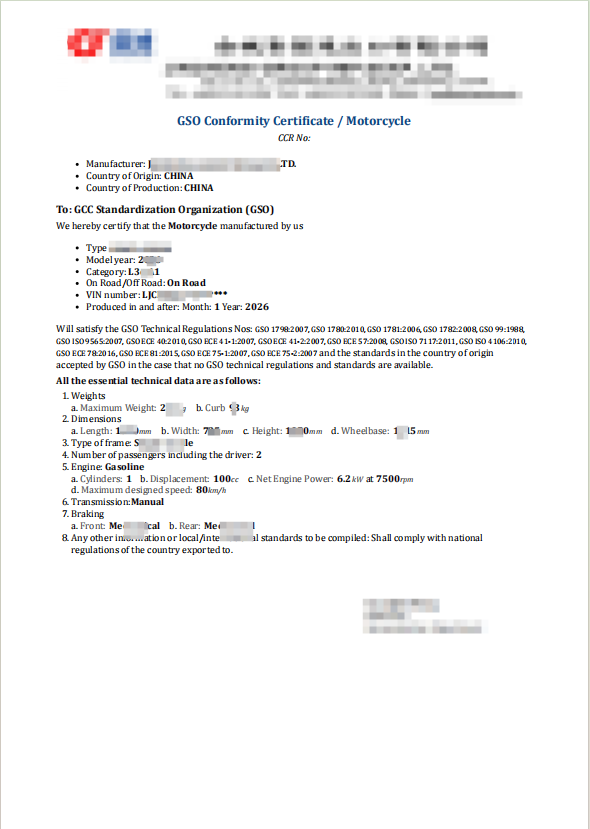
Anonymised specimen · click to enlarge
Read the details, not just the heading.
The supplied specimen includes manufacturer and origin information, vehicle identity, a model year, referenced technical regulations and principal vehicle specifications.
- Check the model, VIN information and vehicle configuration.
- Confirm the declaration and evidence refer to the same vehicle.
- Verify the current approval record through the official platform.
This specimen is for illustration only. It does not establish the validity, approval status or suitability of any current vehicle, and it is not a substitute for an official conformity decision.
Practical questions.
What is GSO motorcycle certification?
GSO authenticates motorcycle conformity certificates through its Mutabiq platform. The application connects a manufacturer's declaration, vehicle technical details and test evidence to the model in scope. Current regulations and destination-country requirements must be confirmed for each application.
Is a GSO motorcycle certificate the same as G-Mark?
No. Motorcycles use a vehicle conformity service. The Gulf marking routes for toys and low-voltage electrical equipment are different programmes.
Does the certificate complete every import requirement?
No. Destination-country import, customs and vehicle-registration requirements must be confirmed separately. A GSO record should not be presented as automatic approval for every market or shipment.
Can we use reports from an existing motorcycle model?
Possibly, but only after reviewing model coverage, configuration, standard editions and acceptance requirements. A similar appearance or engine capacity alone does not establish equivalent evidence.
What should we send for an initial assessment?
Send the model and variant list, model year, vehicle category, technical specification, intended markets, manufacturer information, vehicle photographs and any available reports or certificates.
How long does certification take and what does it cost?
There is no universal quotation or guaranteed approval time. Scope, evidence completeness, additional testing and authority review affect the schedule and cost. Share the vehicle dossier and destination before requesting a case-specific proposal.
Official references.
Requirements can change. Confirm the current motorcycle service, application rules and applicable standards with GSO before submission.
References checked: 17 September 2026. The motorcycle list is an official reference publication; confirm the current applicable editions and portal rules for your application.
Start with your model and destination.
Share the specification and available evidence. We will help identify the next practical step.